We add this page for one reason only

And that is to assist you with some of the theory questions that might come up during your theory test.
We have not covered it all as we are not privy to areas of the theory test that you might be questioned on, but realise there is a lack of information available in certain books for your to learn about a subject that is vast, and not aware of what you might be questioned on during a theory test.

WE DO NOT RECOMMEND THAT ANYTHING SHOWN HERE IS CARRIED OUT ON ANYONE UNLESS YOU HAVE HAD TRAINING IN THE SPECIFIC AREA

What to do in the event of an accident

First and foremost DO NOT PUT YOURSELF AT RISK!!!!!
Guidance from the Highway code is as follows:-

1. DEAL WITH DANGER.
Further collisions and fire are the main dangers following a crash. Approach any vehicle involved with care, watching out for spilt oil or broken glass. Switch off all engines and, if possible, warn other traffic. If you have a vehicle, switch on your hazard warning lights. Stop anyone from smoking, and put on the gloves from your first aid kit if you have one.

2. GET HELP.
If you can do so safely, try to get the assistance of bystanders. Get someone to call the appropriate emergency services on 999 or 112 as soon as possible. They'll need to know the exact location of the incident(including the direction of traffic, eg northbound) and the number of vehicles involved. Try to give as much information about the condition of any casualties, eg if anyone is having trouble breathing, is bleeding heavily, is trapped in a vehicle or does not respond when spoken to.

WHAT THREE WORDS is an excellent mobile phone app to pinpoint your exact location
https://what3words.com/

3. HELP THOSE INVOLVED.
DO NOT move casualties from their vehicles unless there is a threat of further danger.
DO NOT remove a motorcyclist's helmet unless it is essential.
DO try to keep casualties warm, dry and as comfortable as you can
DO give reassurance confidently and try not to leave them alone or let them wander into the path of other traffic.
DO NOT give them anything to eat or drink or smoke.


4. PROVIDE EMERGENCY CARE
Remember the letters DR A B C:
D = DANGER. Check that it is safe to approach
R = RESPONSE. Try to get a response by gently shaking the casualty's shoulders and asking loudly " are you alright?" if the respond, check for injuries.
A = AIRWAY. If there is no response, open the casualty's airway by placing your fingers under the chin and lifting it forward.
B= BREATHING. Check that the casualty is breathing normally. Look for chest movements, look and listen for breathing, and feel for breath on your cheek. If there are no signs of breathing, start CPR, interlock your fingers, place them in the centre of the casualty's chest and press down hard and fast - around 5-6 centimetres and about twice a second. You may only need one hand for a child and shouldn't press down as far. For infants, use two fingers in the middle of the chest and press down about a third of the chest depth. Don't stop until the casualty starts breathing again or a medical professional takes over.
(CPR) = Cardiopulmonary resuscitation is an emergency procedure that can help save a person's life if their breathing or heart stops.
C = CIRCULATION. If the casualty is responsive and breathing, check for signs of bleeding. Protect yourself from exposure to blood and check for anything that may be in the wound, such as glass. DO NOT remove anything that's stuck in the wound. Taking care not to press on the object, build up padding on either side of the object. If nothing is embedded, apply firm pressure over the wound to stem the flow of blood. As soon as practical, fasten a pad to the wound with a bandage or length of cloth. Use the cleanest material available.

CPR

Video by St John Ambulance

BURNS

Put out any flames, taking care for your own safety. Cool the burn for at least 20 minutes with plenty of clean, cool water.
Cover the burn with cling film if available. DO NOT try to remove anything that is sticking to the burn.

SHOCK

What is shock?
Shock can be caused by anything that reduces the flow of blood, such as: severe internal or external bleeding,
heart problems, such as a heart attack, or heart failure, loss of body fluids, from dehydration, diarrhoea, vomiting, or burns,
severe allergic reactions and overwhelming infection (septic shock)
spinal cord injury.

Signs and symptoms
Look for:
Pale skin, which may be cold and clammy
Sweating
Fast pulse - as shock gets worse
Fast, shallow breathing
A weak pulse
Grey blue skin, especially inside the lips
Nausea and possible vomiting - as the brains oxygen supply decreases
Restlessness and aggressive behaviour
Yawning and gasping for air
The casualty could become unresponsive.

Treating Shock

Video by St John Ambulance

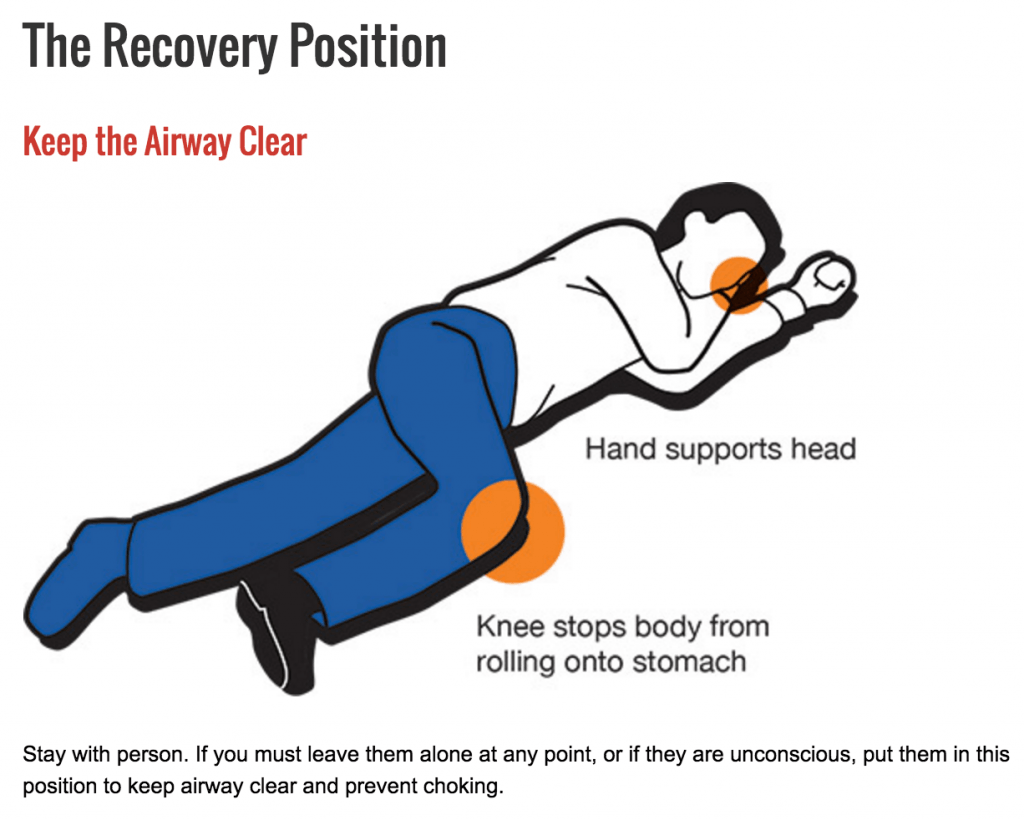
The Recovery Position

The Recovery Position

Video by St John Ambulance

Car Accidents and the First Aider

Video by the First Aid Show

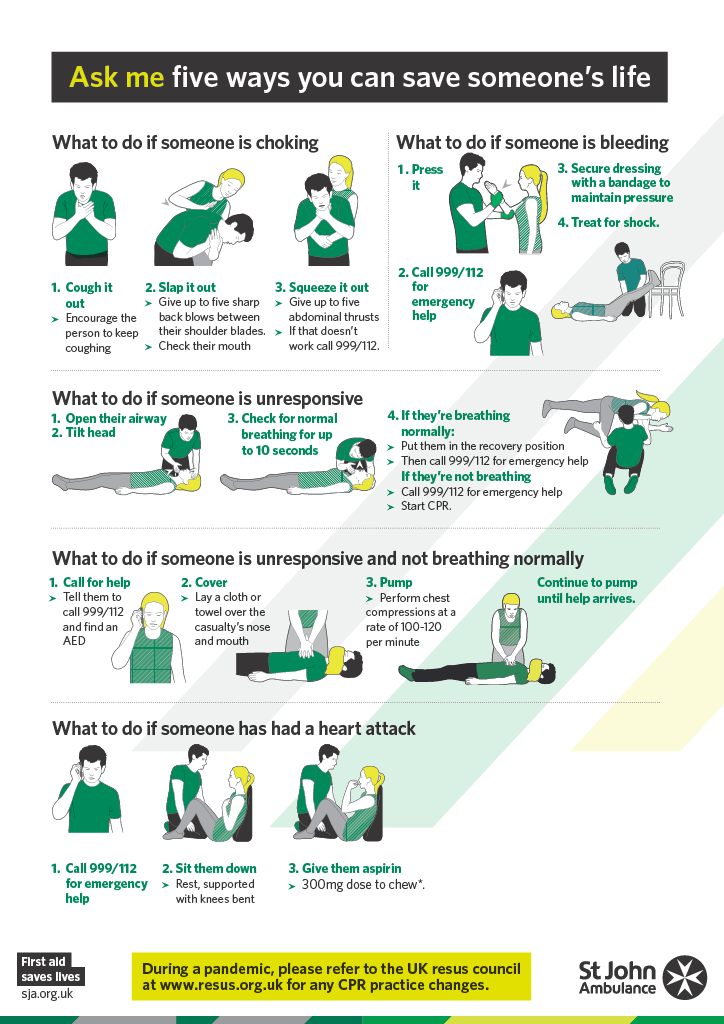
5 ways you could possibly save someone's life.

Information by St John Ambulance

STROKE

If you suspect a Stroke Act FAST and call 999
By calling 999 early, treatment can be given which can prevent further brain damage.
ACT FAST

FACE

Can the person smile?
Has their mouth or eye dropped?
ARMS

Can the person raise both arms?

SPEECH

Can the person speak clearly and understand what you say?

TIME

Time to call 999

NON catastrophic bleeding

Expose and examine the wound for anything embedded such as a shard of glass.
If there is nothing embedded, apply direct pressure with your fingers or palm, preferably over a sterile dressing or non fluffy clean pad.
The casualty or a bystander could help you by holding this in place whilst you prepare your treatment.
Secure a sterile dressing in place.
Elevate and support the injured part.
Help the casualty to lie down and raise the legs if you suspect shock.
If blood seeps through the first dressing, remove it and apply pressure to the bleed with a new dressing. 
Secure the new dressing with a bandage once the bleeding is under control.
IF THERE IS SOMETHING EMBEDDED IN THE WOUND, LEAVE IT IN PLACE AND APPLY THE DRESSING AROUND IT.
Automated External Defibrillator Storage Cabinet

Image by St Johns Ambulance.

AED

A defibrillator, also known as an Automated External Defibrillator (AED), is a critical device used to help someone in sudden cardiac arrest. It’s designed to be easy to use, with clear step-by-step instructions, so whether you're a trained first aider or a bystander, you can take action. Compact and portable, AEDs can be used in nearly any setting. Having one available in workplaces, schools, and public spaces can make a real difference in saving lives.

Common questions about AED's and
Cardiac arrest.

Q. What is an AED used for?
A. An AED is a life saving device that helps to restore normal rhythm to the heart of a victim of sudden cardiac arrest.

Q. What is a sudden cardiac arrest?
A. A sudden cardiac arrest occurs during a electrical malfunction in the heart. Blood cannot be pumped around the body resulting in the brain being starved of oxygen.

Q. What is a CPAD?
A. A CPAD is a Community Public Accessible Defibrillator. These can be sited anywhere, within any location and are easily accessible 24hours a day. All CPAD site are registered with The Circuit, this links them to the ambulance service dispatch system.

Q. Where do most cardiac arrests happen?
A. Approximately 75% of sudden cardiac arrests happen at home.

Q. How many people suffer a Cardiac arrest each year?
A. Data from Resuscitation UK shows more than 40,000 out -of-hospital cardiac arrests occur in the UK each year, but fewer than 1 in 10 people currently survive.

Q. What is a Cardiac arrest?
A. A Cardiac arrest is when your heart suddenly stops pumping blood around your body. This can be caused by:
Dangerous heart rhythm disorders.
A heart attack. This is when blood flow to part of the heart muscle is blocked, which can then trigger dangerous heart rhythms that stop the heart from pumping effectively.
Heart muscle and structural problems
Severe blood loos or oxygen shortage
Other factor, such as electrocution or drug overdoses.

Q. How soon should an AED be used?
A. The earlier treatment starts, the better the outcome. The first three to five minutes are crucial for the victim. If CPR can be carried out and a defibrillator used the greater the chance of survival. Every minute without CPR and defibrillation reduces the chance of survival by up to 10%

Q. Do I need to call 999 if I get an AED from a cabinet?
A. Yes. You will still need to or get someone else to ring 999 if you are dealing with a victim.

Q. Do I need training to use a Defibrillator?
A. The UK Resuscitation Council guidelines state that there is no requirement to be trained in the use of an AED, and if a person collapses, the non-trained person should still use the AED.

Q. What if I don't know what I am doing?
A. An AED unit not only provides visual prompts to the user, but also verbal prompts.

Q. Are Defibrillators safe to use?
A. Yes. Defibrillators are safe to use and will guide you through the process. They are designed to detect specific electrical activity and will only shock as and when needed.

Q. Can I be sued for using for attempting to resuscitate a collapsed individual?
A. The likelihood of suing a potential rescuer is extremely low. It would be necessary to prove, in English Law, that the intervention had worsened the victim's situation than if the intervention had not taken place.

Q. What should I look for is someone is having a Cardiac arrest?
A. Signs and symptoms that may suggest a person has bone into a cardiac arrest include:
They appear not to be breathing.
They are not moving.
They do not respond to any stimulation, such as being touched or spoken to.

Q. Who can use an AED?
A. Anyone.

Q. what should I do if it's raining or the victim is wet?
A. Despite the potentially risky mix of electricity and water, AEDs can indeed be used safely in wet environments, even in conditions where the victim is lying outside in the rain or snow. To ensure safety, it’s critical to follow several steps if the victim is found in a wet environment:
If the victim is in the water, safely move them to a dry area and away from any puddles or water bodies.
Remove any wet clothing from the victim and dry their chest thoroughly.
Ensure all bystanders move away from the wet surface and the victim.

Q. Can I use an AED on a child?
A. If the casualty is a child between the age of 1 and 8, the pads are placed differently. Place one pad in the middle of the chest and the other on the back between the shoulder blades. You should ideally use paediatric pads, but if these aren't available then adult pads can be used in the paediatric position.


CPR AEDs and the law click here for further information

Defib Dani

Video by the ResusCouncilUK

Video Description

© Copyright 2025 ADI-PDI-Resource -
All Rights Reserved

Shop

Home

About us


We would like to thank Freepik 
for a percentage of content images on this site

adipdiresource@gmail.com

07765510704